Pantheismmenubann.jpg (13666 bytes)

Start or attend a local group

This page offers help in contacting local pantheist groups and also creating, organizing and publicizing local meetings.

World Pantheism is using Upcoming.org to galvanize the creation of local groups.
[If you belong to a Unitarian Universalist congregation, check here for advice on forming a Nature-Reverence/Pantheism group in your congregation.]

To maximize potential attendance we have called our Upcoming group Nature Reverence. It is open to all people who feel that reverence for nature and respect for naturalism are central to their spirituality, whether you call yourself world pantheist, eco-atheist, naturalistic pagan, religious naturalist, or religious humanist.

Nature Reverence is an umbrella group for meetings that fit the bill. It's up to users to create events for people in their area, what Upcoming does is act as a public notice board and organizing facilitator.

Upcoming.org allows individuals and groups to organize and publicize events and get-togethers. Although the company was acquired by Yahoo late in 2005, the service is completely free and commits itself to remaining so. Costs may eventually be met by ads relevant to your groups and locations, but we haven't see any yet. You can join interest groups, search for events by place and topic, create and add events, and add venues of your own choosing.

Note: World Pantheism previously used Meetup.com. We were doing well there, growing very fast, and things were rolling. But then Meetup introduced steep fees ($144 - $228 per year) for anyone wanting to organize a group in their locality. Without an organizer no events could happen.
While large existing groups could agree to a small fee to meet the organizers' expenses, it was no longer realistic for anyone to start new local meetings on the offchance that people might turn up.


All Nature Reverence events

Join Nature Reverence events (free)


Join Upcoming.org's Free Nature Reverence Group

Step 1 Register with Upcoming.org
Step 2 Click on the activation link sent you by mail
Step 3 Log in
Step 4 Read Upcoming's FAQ about First Steps
Step 5 Choose your town and nearby cities
  You can choose any number, all around you.
Step 6 Join the Nature Reverence Group


Search for events in your area.

Be patient, we only started at the end of February so this will take a while to come together.
Better still, plan and start your own event, it needn't be elaborate, it can be just a getting to know people thing.
Read the planning section below for more developed or regular meetings.
 

When you feel ready, create an event

Step 1 Read Upcoming's FAQ about adding an event
Step 2 Go to your Metros page
Step 3 Click "Add New Event" next to the location where you want to hold one.
This will bring up a form to fill in.
[You can add it to more than one location.]
Step 4 Add date, times, event name, and description. Description is important as it's used for keywords, here's a good one that covers buzz words:
[Place etc] meeting of the local Nature Reverence group, featuring sharing of views and experience, discussion of our spirituality, and occasional outings. Intended for all those who feel that reverence for nature and respect for naturalism are central to their spirituality, whether you call yourself world pantheist, eco-atheist, naturalistic pagan, religious naturalist, or religious humanist. [Pantheism, humanism, naturalism, atheism]
Step 5 Choose a venue or add a new one.
This can be a cafe, park, public building or private home 
Step 6 Review your event and add it
NOW LOOK AT THE OTHER MENUS ON THE EVENT PAGE
    YOU HAVE JUST CREATED
Step 7 Add tags, eg Nature, pantheism, humanism, naturalism, atheism, environment
Step 8 Send to groups: Choose "Nature Reverence"
Step 9 Publicize your event on your local WPM state or country list
 

Plan regular meetings

Themes
 
            It’s important for regular meetings to have ideas for  what your group is going to do and discuss, and what format it will take. Listen to and be responsive to the interests and wishes of people who attend, unless they clearly conflict with the whole purpose of the group. And here are some suggestions.

Meeting Formats
         
It helps to have a standard meeting format that is spiritually satisfying, allowing for social and intellectual exchanges as well as sensory  and emotional experiences. You may wish to modify the format in the light of rgular members’ wishes and suggestions.
            Bear in mind that you will be wanting to engage the widest possible range of members so beware of biases such as getting too deeply into florid supernatural-sounding ritual – and also of turning into a dry debating club without any emotional, personal or aesthetic content. Either of these extremes can reduce your broader appeal.
            You may wish to hold the meetings at a member’s home, or in a room of the building where your congregation holds it services.
            Here’s a format that has worked well at the Conejo Valley Nature Reverence Group, in Thousand Oaks, California.

Music and decor
            If you are in a locale that permits this, as people arrive a CD is playing of natural sounds – it might be birdsong, whalesong, frogsong, running water, ocean waves, thunderstorm. There are many CDs available with this kind of music and you can find a selection here.
            At the center of the meeting circle there may be various natural objects – beautiful rocks, tree bark, seeds, flowers, candles.

Spiritual Checkin
            We begin with the checkin. Instead of talking generally about what’s been happening in our lives, we focus on deeper experiences, discoveries and insights we have had since we last met, whether of life, nature, science, or ethics.
            Some people use this opportunity for “Show and Tell” and bring in  photographs they have taken, stimulating articles they have read, or some natural item they have collected – a rock, a flower, a seed. But please observe all rules about collecting – don’t take native flowers, seeds or shells unless they are very common.

Discussion topic
            To save floundering around it may be a good idea to have a discussion topic for each session - a subject or a book
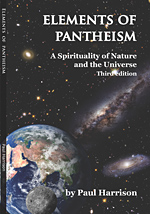
            A good basis for this would be Elements of Pantheism by Paul Harrison – the only comprehensive but short and accessible introduction to pantheism/nature reverence in print. You could work through the book chapter by chapter.
           Other books that can be used as the basis for a subsequent  "course" are The Circle of Simplicity by Cecile Andrews, which examines practical green lifestyles.
           Or try Ursula Goodenough's The Sacred Depths of Nature, which gives a brief stage-by-stage presentation of science's picture of evolution with some spiritual reflections .

Questions and Answers
            If there are newcomers you might want to allow five or ten minutes for a very brief summary of what pantheism/nature-reverence is and involves, and a chance for them to ask questions. You might find the
Pantheist FAQS and the World Pantheist Movement FAQS useful background.

Guided meditation
            At some meetings we set aside a time of five minutes or so when members can reflect to natural sounds, or guided by words about our roots in and connections with cosmos, sun, fire, air, rocks, soil, water, life and other central features of the natural universe.

Choice of next topic, outings, suggestions for development

            You might want to choose the topic for the next meeting at the end of each meeting and discuss possible outings and actions to publicize your group or attract new members.

Activities
         
It’s also a good idea not just to sit there talking every time, but to spice up the year with outings and activities.
Hikes:  You might want to plan nature hikes, taking care to offer easy and moderate hikes so as to maximize participation.
Nature watch: Arrange outings to observe special events in nature - meteor showers, full moons, auroras, migrations of birds, butterflies and whales, seasonal blossomings and autumn leaf displays.
Site outings: Members may be interested in visits to science and nature exhibits, botanical gardens, green buildings, recycling centers, water and sewage plants, composting facilities.

Green Action
         
Once you have got started, your group may want to get involved in the practical side of pantheism/nature-reverence.
            You may want to talk about practical changes you can undertake to make your own life more sustainable - at home, in the garden, at work, in transport and travel. You can use the World Pantheism "Greenup your life" page as a source of practical local links for any location in the USA.
            You may want to join in volunteering for some local environmental project such as creating a communal garden, restoring damaged habitats, or planting native species.


menubann.jpg (13666 bytes)